Canang sari is the small, hand-folded tray of palm leaf, flowers and a little food that Balinese Hindus offer every day to say thank you to God, Ida Sang Hyang Widhi Wasa, and the gods. You'll see them on doorsteps, shop counters, shrines, car dashboards and crossroads all over Ubud. It's the simplest everyday offering, and every bigger offering contains one. For Balinese, an offering that has been placed isn't moved or stepped on. If you step on one by accident, don't worry, it happens.
What does canang sari mean?
Canang is usually explained as betel, the leaf served to honoured guests in old Javanese and Balinese tradition, and sari means essence. Another popular reading splits the word into ca, beautiful, and nang, purpose. Neither is settled, but both point the same way: a small, beautiful offering that holds the essence of the prayer.A canang sari is mainly a way of saying thank you and showing gratitude. Balinese link it to Tri Hita Karana, the balance between people and God, between people, and between people and nature. Everything in it comes from nature and goes back to it. Tradition credits the priest Mpu Sangkulputih with creating it.
For more on the beliefs behind the offerings, see Balinese Hinduism.
What is inside a canang sari?
Every part has a meaning. Balinese explanations vary, so the meanings below are the ones most often given.- Ceper: the square base tray, folded from young coconut leaf and pinned with thin bamboo slivers, or today often with staples.
- Porosan: betel leaf folded around lime paste and areca nut. It's called the soul of the offering, and a canang without it isn't complete. According to the old palm-leaf manuscript Yajna Prakerti, as it's commonly explained, the areca nut stands for Brahma, the betel for Wisnu and the lime for Siwa.
- Sugar cane, banana and a little cake: small pieces of food under the flowers, the fruits of the earth.
- Sampian urasari: the round palm-leaf crown with pointed tips that the flowers sit on.
- Flowers: marigold, frangipani, bougainvillea, hibiscus and others, laid out by direction.
- Shredded pandan leaf: called rampe, for fragrance, often in the centre.
- Incense: a stick of dupa, lit when the canang is offered. The smoke carries the prayer up.
Without the sugar cane, banana and cake, the offering is strictly called uras sari, which is fine for personal prayer. You may also see biscuits, sweets, a cigarette or a sachet of coffee on top. Those are personal extras, not part of the tradition.
Why do the flowers in a canang face different ways?
Each colour points to a direction and honours one manifestation of God. The flowers are traditionally laid out clockwise, starting from the east.- East: white, for Iswara.
- South: red, for Brahma.
- West: yellow, for Mahadewa.
- North: black, for Wisnu. Black flowers are rare, so blue, purple or other dark flowers are used.
- Centre: mixed colours, for Siwa, though the centre is usually the shredded pandan.
Canang bought at the market often have the flowers placed more loosely, so not every one you see follows the full layout.
Who makes canang sari, and when?
Mostly women, and mothers teach their daughters, though men make and place offerings too. Most families place them every morning, usually after cooking and before the family eats, and many do a second round in the late afternoon. Making a household's offerings can take an hour or two a day, and much longer before big holidays.Where are canang sari placed? Wherever daily life happens: the family temple and its shrines, the house gate, the kitchen, shops, restaurants and hotels, car dashboards and scooters, crossroads, bridges, rivers and beaches.
When there's a death in the family, the household is in a period called sebel and doesn't make offerings for a while.
Why are some offerings on the ground?
Offerings placed high, on shrines and raised places, are for God, the gods and the ancestors. Canang sari placed on the ground are for the bhuta kala, the lower forces, to keep the balance. On certain days, families also offer segehan, a separate offering of rice with shallot, ginger and salt.The bhuta kala aren't evil demons to fight off. They're part of creation, and the offering keeps them calm, so the home stays in balance. Every 15 days, on Kajeng Kliwon, families place segehan in three spots: the family temple yard, the house yard and outside the gate.
How is a canang sari offered?
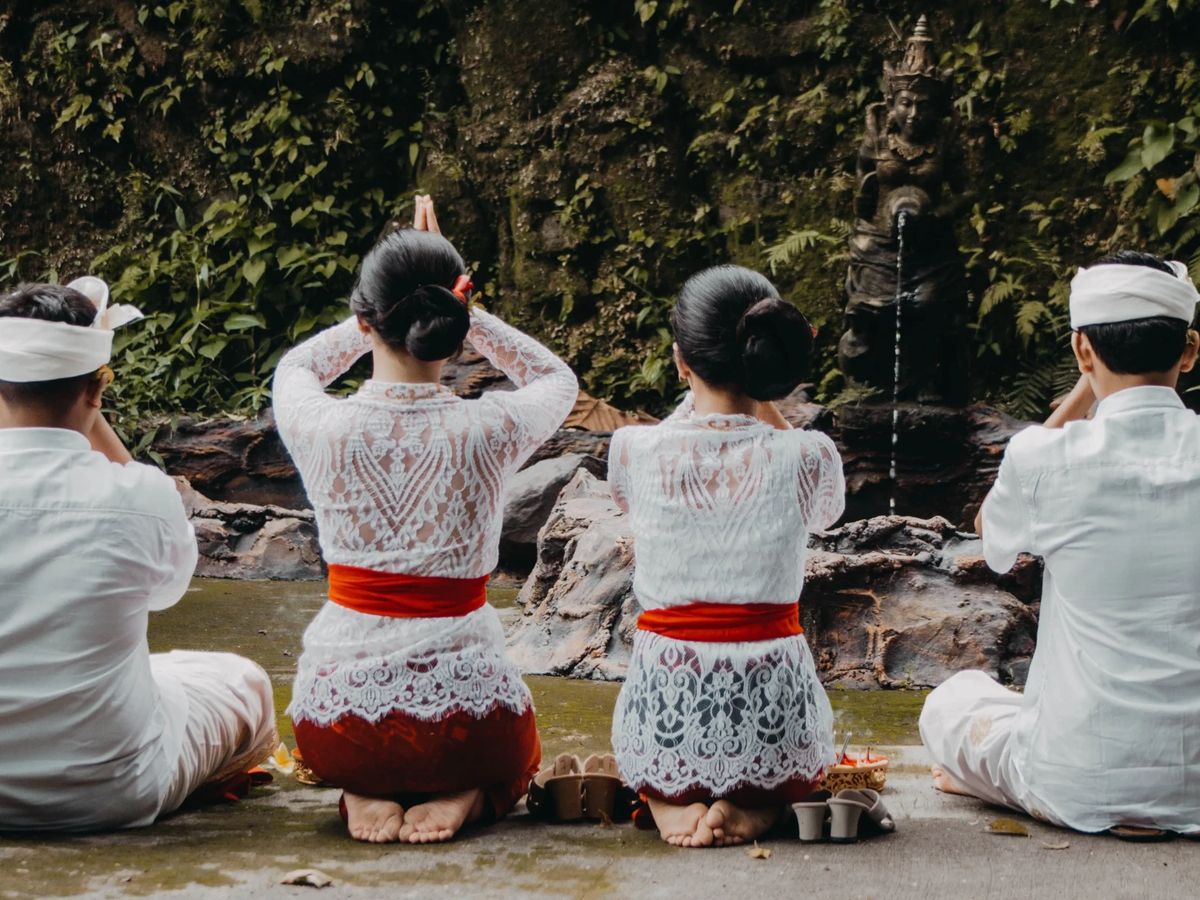
The canang is set down with its colours facing their directions, and a lit stick of incense is tucked in. Holy water is sprinkled over it with a flower held between the fingers. Then, with the right hand, the person gently wafts the smoke and fragrance toward the shrine, often with a short prayer said quietly.For praying at a temple, see Temple Etiquette & Dress.
What's the difference between canang sari and saiban?
Both are everyday offerings, and both are a way of saying thank you. Saiban is the simplest: a small piece of banana leaf with a few grains of cooked rice, offered every morning right after cooking, before the family eats. Some families offer saiban every day, some offer canang sari, and many do both.Can you buy canang sari?
Yes, and many families do. Markets have a canang section with bundles of ready-made canang, plus loose flowers and trays for people who make their own. Many women work full time and can't make every offering themselves. A bought canang counts the same as a homemade one: what matters is that it's complete and offered with a sincere heart. You'll find the canang sellers at Ubud Market in the early morning.Traditionally everything in a canang is organic. Today staples and plastic-wrapped sweets end up in the waste too, and Balinese communities are working on composting offering waste and going back to natural materials.
How should you act around canang sari?
For Balinese, canang sari is a symbol of gratitude, and we hope visitors treat it with the same respect. Balinese never step on an offering on purpose, so if you see one on the pavement, just walk around it. If you step on one by accident, don't worry.Dogs, chickens and monkeys eating the offerings is normal. Once a canang is offered, the essence is received, and what's left is just material. Old, flattened canang are swept up each morning before new ones go down.
Can you learn to make one? Yes. Many family compounds, resorts and workshops in and around Ubud run short canang classes, usually one to three hours, where you fold the tray and learn what each part means.
Local tip: guests often tell me, a bit worried, that they stepped on a canang. I always say the same thing: don't worry. It happens every day on busy streets. What matters to us is respect, and the fact that you care already shows it.
In short, canang sari is a daily offering to say thank you and show gratitude. It holds betel, a little food and flowers set out by direction. Offerings up high are for the gods, and offerings on the ground are for the lower forces, to keep the balance. Saiban is the simplest everyday offering, a little rice on a leaf after cooking. Balinese walk around offerings and don't step on them on purpose, but if you step on one by accident, don't worry. Dogs and chickens eating them is normal, and many Balinese families buy their canang at the market.
Frequently asked questions
What is canang sari made of?
A small tray of young coconut leaf holding betel leaf with lime and areca nut, a bit of sugar cane, banana and cake, and flowers set out by direction. Incense and holy water are added when it's offered.
What flowers are used in canang sari?
Mostly marigold, frangipani, bougainvillea and hibiscus, picked for their colours.
Why is incense placed on a canang sari?
The stick of incense, called dupa, is lit when the canang is offered. Its smoke carries the prayer up, and its fragrance is part of the offering.
How often do Balinese make canang sari?
Every day, usually in the morning and often again in the afternoon, with more on full moon, new moon, Kajeng Kliwon and holidays like Galungan.
Can tourists make canang sari?
Yes. Many family compounds and workshops in Ubud run short canang-making classes where you learn what each part means.